Architecture
Designed trust zones, addressing standards, service placement, management paths, and production-versus-development boundaries.
Infrastructure case study / Operating environment
I designed, migrated, and now operate a segmented Proxmox and OPNsense environment supporting household services, surveillance, monitoring, remote administration, and development workloads.
01
This is not a collection of disconnected demos. It is a continuously operated environment with real users, dependencies, maintenance work, and failure modes.
The project began after a power outage exposed a circular dependency between virtualized routing and hypervisor management. Rather than restore the same flat design, I rebuilt the environment around segmentation, recoverability, observability, and controlled administration.
Designed trust zones, addressing standards, service placement, management paths, and production-versus-development boundaries.
Deployed OPNsense routing, Proxmox workloads, Docker Compose stacks, shared storage, DNS, DHCP, and remote access.
Monitor health, investigate failures, maintain services, validate storage, and perform bounded recovery actions through Ansible.
Maintain architecture decisions, addressing standards, service inventories, troubleshooting notes, and recovery procedures.
02
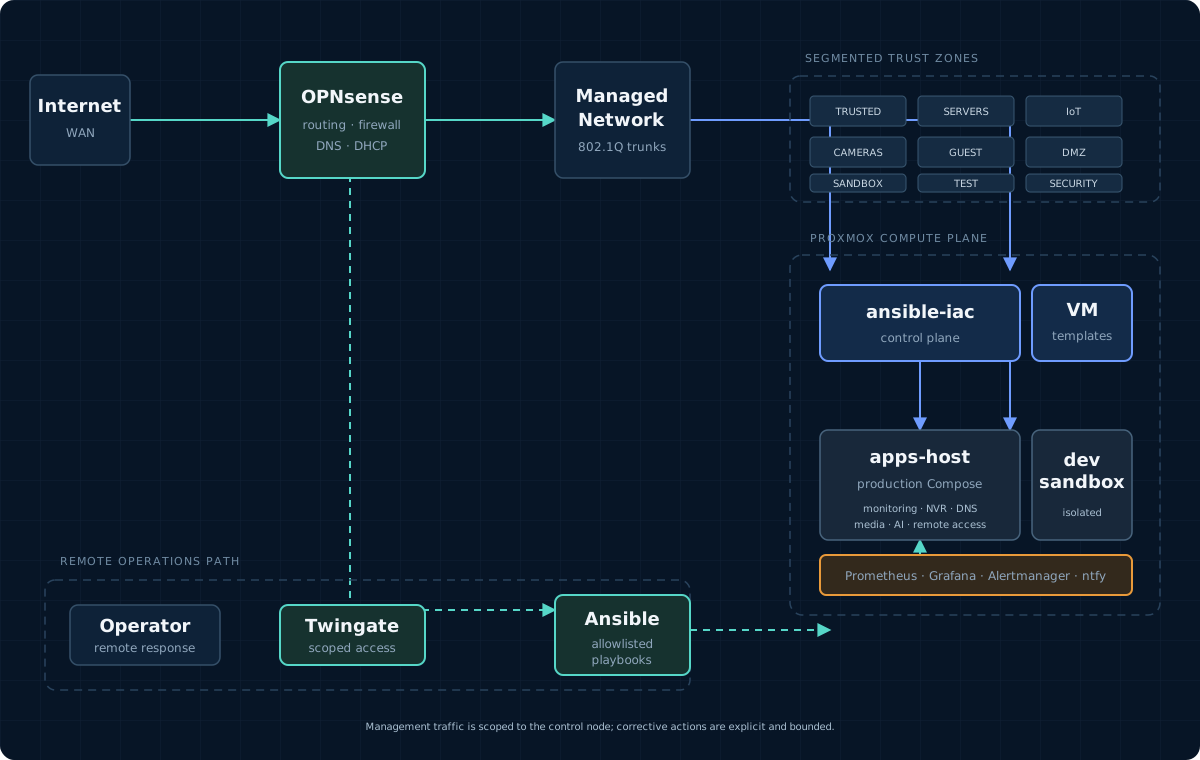
The management path is deliberately narrower than the service network. Remote administration terminates at the control node, and corrective actions are explicit rather than unrestricted.
Decision 01
Compose provides repeatable deployment without introducing orchestration complexity that the environment does not need.
Decision 02
Household services run on the application host; development work runs on an isolated sandbox host.
Decision 03
Management, trusted, server, IoT, camera, guest, DMZ, sandbox, test, and security workloads have distinct policy boundaries.
Decision 04
Twingate reaches the Ansible control node; fleet actions pass through fixed playbook and action allowlists instead of broad root shells.
03
The value of the project is not only that it was built. It is monitored, diagnosed, maintained, and recovered as an ongoing system.
Platform
Network
Applications
Observability
04
Each capability is tied to something designed, deployed, or operated in the environment.
| Capability | Implementation evidence | Tools and platforms |
|---|---|---|
| Network architecture | Nine tagged VLANs organized around trust, service role, and blast-radius reduction | OPNsense, 802.1Q, managed switching |
| Firewall administration | Inter-VLAN policy, WAN routing, state-table validation, DNS and DHCP service checks | PF, Unbound, Kea DHCP |
| Systems administration | Virtual machine lifecycle, templates, host diagnostics, storage health, and capacity review | Proxmox VE, Linux, ZFS, SMART |
| Infrastructure automation | Repeatable diagnostics and bounded corrective actions executed from a dedicated control node | Ansible, OpenTofu, Git |
| Container operations | Production and development Compose stacks with service-level diagnostics and controlled restarts | Docker Compose, Traefik, Portainer |
| Observability | Metrics, dashboards, target health, alert routing, container telemetry, and uptime checks | Prometheus, Grafana, Alertmanager, cAdvisor |
| Security engineering | Scoped remote access, trust-zone isolation, action allowlists, and restricted management paths | Twingate, OPNsense, Ansible |
| Incident response | Runbook-driven diagnosis for firewall, NIC, container, GPU, storage, and camera failures | Logs, metrics, health checks, recovery playbooks |
05
A failure is most valuable when it changes the system instead of only being repaired.
Case: management-plane loss
Power recoveryA virtualized router failed to restore normal connectivity after a power outage, making the hypervisor difficult to reach.
The design coupled routing, management access, VM startup order, and NIC initialization into one failure path.
Preserved a dedicated management path, defined router startup priority, documented fallback access, and added restricted remote diagnostics.
Management and recovery paths must remain usable when the production routing path is impaired.
06
A credible infrastructure case study should show what remains imperfect and how risk is being managed.
The active ZFS pool has no disk redundancy and has recorded read errors. Independent backups, scheduled verification, and tested restores reduce the risk while storage remediation remains pending.
The hypervisor NIC has a known recurring hang pattern. Diagnostics, link-state checks, and recovery validation are documented.
Public diagrams are sanitized. Detailed addresses, identifiers, credentials, and recovery internals stay out of the portfolio.
Nightly backups, weekly verification, and real restore tests are operating. The remaining priorities are an offsite copy and replacing or adding redundancy to the at-risk application-storage disk.
Hands-on infrastructure ownership
The environment gives me practical experience planning changes, managing risk, troubleshooting failures, automating repeatable work, and maintaining services that other people rely on.